Introduction
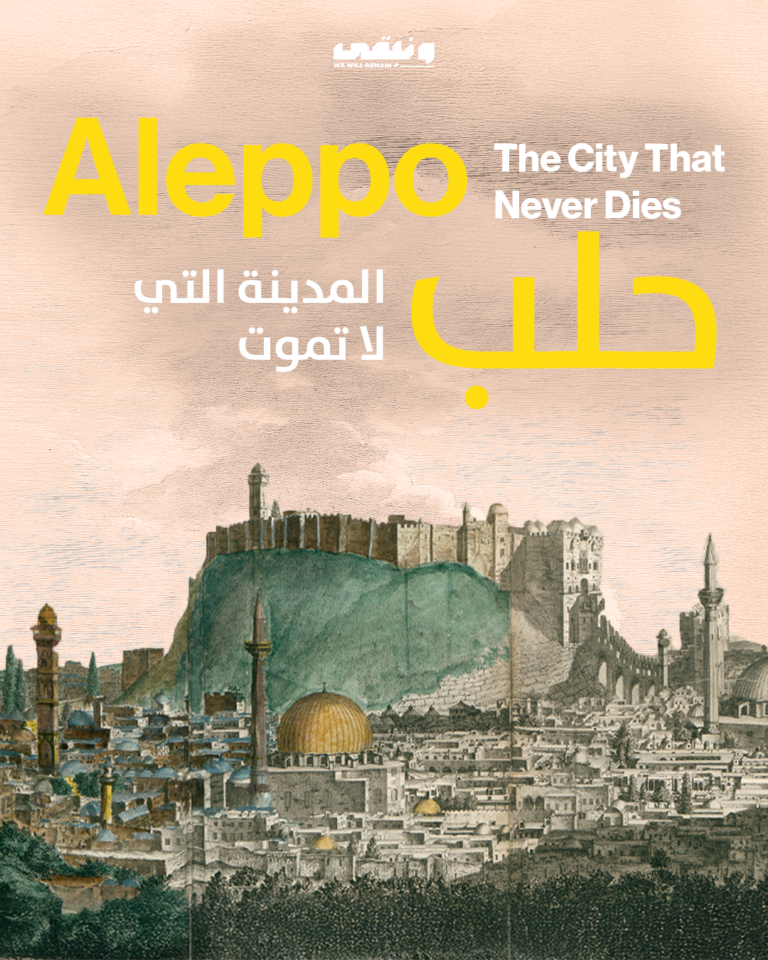
Aleppo is one of the oldest continuously-inhabited cities in the world, a testament to resilience. Time and again, it has been destroyed by war, invasions, and natural disasters—yet each time, it was rebuilt. From ancient trade routes to its role as a cultural and commercial hub, Aleppo has adapted and thrived. Even after devastation from the Mongols, Tamerlane, and powerful earthquakes, its people preserved their heritage while shaping a prosperous future. Today, and despite the toll of war and the 2023 earthquake, Aleppo stands once more at the threshold of renewal. It is not merely a city that survives—it is a symbol of endurance, hope, and the unwavering power of rebirth.
Name & Origin
Aleppo is one of the world’s oldest continuously-inhabited cities with traces of settlement dating back to the sixth millennium B.C.E. Despite wars, natural disasters, and conquests, it has remained a center of culture, trade, and civilization. Known as Halab in Arabic, Aleppo inherited its name from Semitic roots, with its earliest mentions tracing back as early as the 3rd millennium B.C.E. texts from Ebla, a prominent civilization in the historical region of Syria known for its early writing system. Over time, Aleppo has had many names, such as Halabu, Halaba, and Beroea, reflecting the cultures and empires that shaped it.
Waves of Destruction
Aleppo’s turbulent history includes devastating natural disasters and invasions, each leaving its mark on the city’s landscape. The 1138 earthquake killed 230,000 people, leaving the city in ruins. In 1260, Mongol forces under Hulagu Khan sacked Aleppo, burning the Great Umayyad Mosque and plundering its markets. In 1400, Tamerlane’s forces inflicted another wave of destruction, setting large parts of the city on fire and enslaving many of its people. The 1822 earthquake further devastated the city, collapsing minarets, citadel walls, and entire neighborhoods, with a death toll estimated between 30,000 and 60,000.
Reconstruction Under the Ayyubids
Amid the destruction, one of the landmarks that stood as a symbol of Aleppo’s resilience was The Citadel. After the 1138 earthquake, much of the citadel’s walls and towers collapsed, leading to extensive rebuilding under Nur al Din Zengi (1146–1174), who also restored and expanded the Umayyad Mosque after being ravaged by a great fire. In 1183, Salah al-Din al-Ayyubi captured the city, marking the start of a period of prosperity. Under Ayyubid rule, Aleppo flourished as one of the most-thriving cities in the region. Under the rule of al-Zahir Ghazi (1186–1216), the Citadel’s fortifications were reinforced with thicker walls and its defensive towers were expanded. The water-supply system was repaired and upgraded, and the markets grew in size and activity. New gates were also built or restored, one of which is the northern Bab al-Nasr in 1212.
A Trade Hub in the Mamluk and Ottoman Eras
The Mongol invasion in 1260 left Aleppo in ruins but the city was shortly reclaimed by the Mamluks, who undertook extensive restoration efforts. The Umayyad Mosque, which had been burned and looted, was restored by the end of the 13th century. Al-Sultaniyyah Madrasa, a renowned center of Islamic learning completed in 1223, was also repaired in 1469. Through these continuous restorations, Aleppo’s religious and cultural legacy endured despite cycles of destruction.
Aleppo’s resilience was also forged through its crucial role as a trade center. With each disaster, new caravanserais, souks, and infrastructure emerged. Khan al-Sabun, built in the 15th century under the Mamluks and rebuilt after the 19th-century earthquake, became a key hub for Aleppo’s famed soap industry. The grand Khan al-Jumruk, completed in 1574 and restored after the 1822 earthquake, became the largest khan in Aleppo’s thriving trade. Khan al-Wazir, constructed in 1678 during Ottoman rule, expanded Aleppo’s trade networks, while Souq al-Madina, the world’s largest covered markets, was continuously rebuilt and restored after fires and conflicts. These reconstructions ensured that Aleppo remained a major trade hub along the Silk Road.
Reconstruction After the 19th Century Earthquake
The 1822 earthquake was one of the worst natural disasters to ever strike Aleppo, collapsing the Citadel’s walls and damaging major landmarks. In response, the city underwent extensive reconstruction throughout the 19th and early 20th centuries. The Great Mosque and surrounding neighborhoods were rebuilt, ensuring the city’s revival. Hammam Yalbugha, a historic bathhouse from 1491, was heavily restored between 1983 and 1985, preserving a centuries-old cultural tradition.
Despite the immense challenges Aleppo has faced, the city continues to embody hope and resilience. The war in Syria inflicted unprecedented damage on its heritage, and the 2023 earthquake further devastated its historical sites. Many of its people were displaced, leaving behind homes and memories. Yet even in exile, Aleppines carry their heritage with them, keeping their traditions alive across the world. Still, the city endures. Its markets are reopening, its landmarks are being restored, and its cultural life is slowly returning. Time and again, Aleppo has risen from devastation, and today, it stands once more as a testament to resilience.